Shopify vs Shopee: Your Own Online Store or a Marketplace?
Compare Shopify and Shopee for Malaysian sellers. Review store control, customer acquisition, fees and daily operations to choose your next sales channel.

On this page10 sections
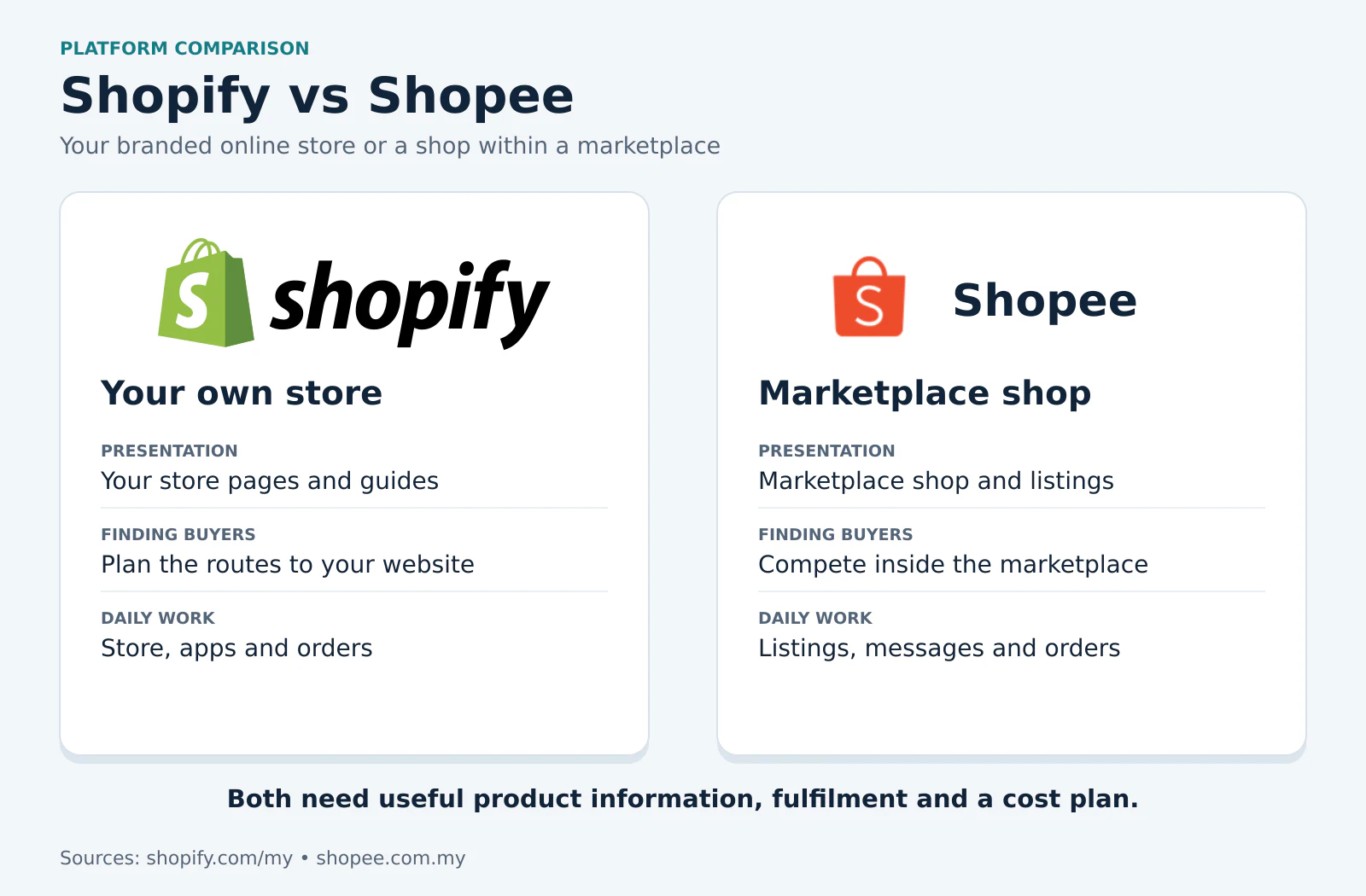
Think of Shopee as opening a shop inside a shared shopping centre. Customers use the same marketplace to browse, compare and buy. You work within that environment and its rules.
A Shopify store is more like setting up your own branded shopfront. You decide how to present your range within the platform's features, but you also need a plan to bring people there. Shopify provides the store platform; Shopee provides a marketplace in which your shop operates.[1][2]
For a Malaysian seller, the choice comes down to customers, costs and daily work. You can use both. The question is whether each channel has a clear purpose and leaves enough money after the order is completed.
Where will the customer come from?
On Shopee, someone can discover your listing while comparing products in the marketplace. You still need a clear listing, suitable pricing and reliable service. Being listed does not mean every customer will see you.
With your own store, think about the route to the website. Will existing customers reorder there? Will people arrive from search, social content, a campaign or a recommendation? If the answer is “we will work that out later,” include that work in the plan before paying for the store.
Imagine two businesses. One is testing a small range of familiar household items. Another sells a specialised product that needs explanation, and already has repeat customers. They may benefit from different starting points because their customers need different things before buying.
What does your own store let you explain?
When customers need to understand the product, a website can organise the information around their questions. You can plan buying guides, comparison pages, product categories and a clear route to purchase.
For example, someone choosing a water filter may need to understand installation, replacement parts and maintenance. A store can bring those answers together so the customer does not have to request the same information in several messages.
On a marketplace, you work with its listing and shop features. That can be a practical setup for products people already understand. Check how well those features present your product and support the way you sell.[2]
| Business question | Independent Shopify store | Shopee shop |
|---|---|---|
| How will buyers arrive? | Plan the routes to your website | Work on marketplace discovery and promotion |
| How will we explain the product? | Organise your own store pages and guides | Use the available shop and listing features |
| What controls the selling environment? | Your setup plus platform and provider requirements | Marketplace rules and seller tools |
| What does the team manage? | Website content, orders, payments and connections | Listings, messages, orders and programme choices |
More control also means more work to organise. Choose the amount of responsibility your team can handle.
Compare the full bill on each channel
On Shopee, look at the completed-order statement. Its Malaysian terms describe several possible fee layers, including transaction fees, commissions, platform-related charges and programme costs. The total depends on the category, seller circumstances and services used, with tax treatment also relevant.[2]
One percentage will not describe every seller. Include seller-funded discounts, promotion and delivery costs where they apply. Your own statement is more useful than someone else's general claim about what the platform takes.
For Shopify, the live Malaysia page showed Basic at RM99 per month, or RM89 per month equivalent with yearly billing, on 1 November 2026.[1] Add the other costs your store needs: setup, domain, paid apps, payment processing, applicable third-party transaction fees, marketing and support.[1][3]
A marketplace fee and a website subscription pay for different things. Compare what it takes to obtain and complete an order on each channel, rather than placing those two numbers beside each other and stopping there.
How much is left from a RM100 order?
Try this calculation using your actual figures:
Sales income − product cost − packing and delivery − channel and payment charges − marketing cost = amount left before overheads and tax.
Here is a hypothetical example to show the arithmetic:
| Item | Amount |
|---|---|
| Order income | RM100 |
| Product cost | −RM45 |
| Packing and delivery | −RM8 |
| Channel and payment charges | −RM12 |
| Marketing allocation | −RM20 |
| Left before overheads and tax | RM15 |
These are example amounts, not Shopee or Shopify fee rates. Replace them with your own costs, including refunds and unsuccessful deliveries where relevant.
More orders are useful when they contribute to the business. If promotions produce a large order count but little money remains, review the offer and the channel costs before spending more.
Also consider your team's time. If every order needs a manual stock correction or several messages to explain the product, that is work you must keep paying for.
Running both channels needs a stock plan
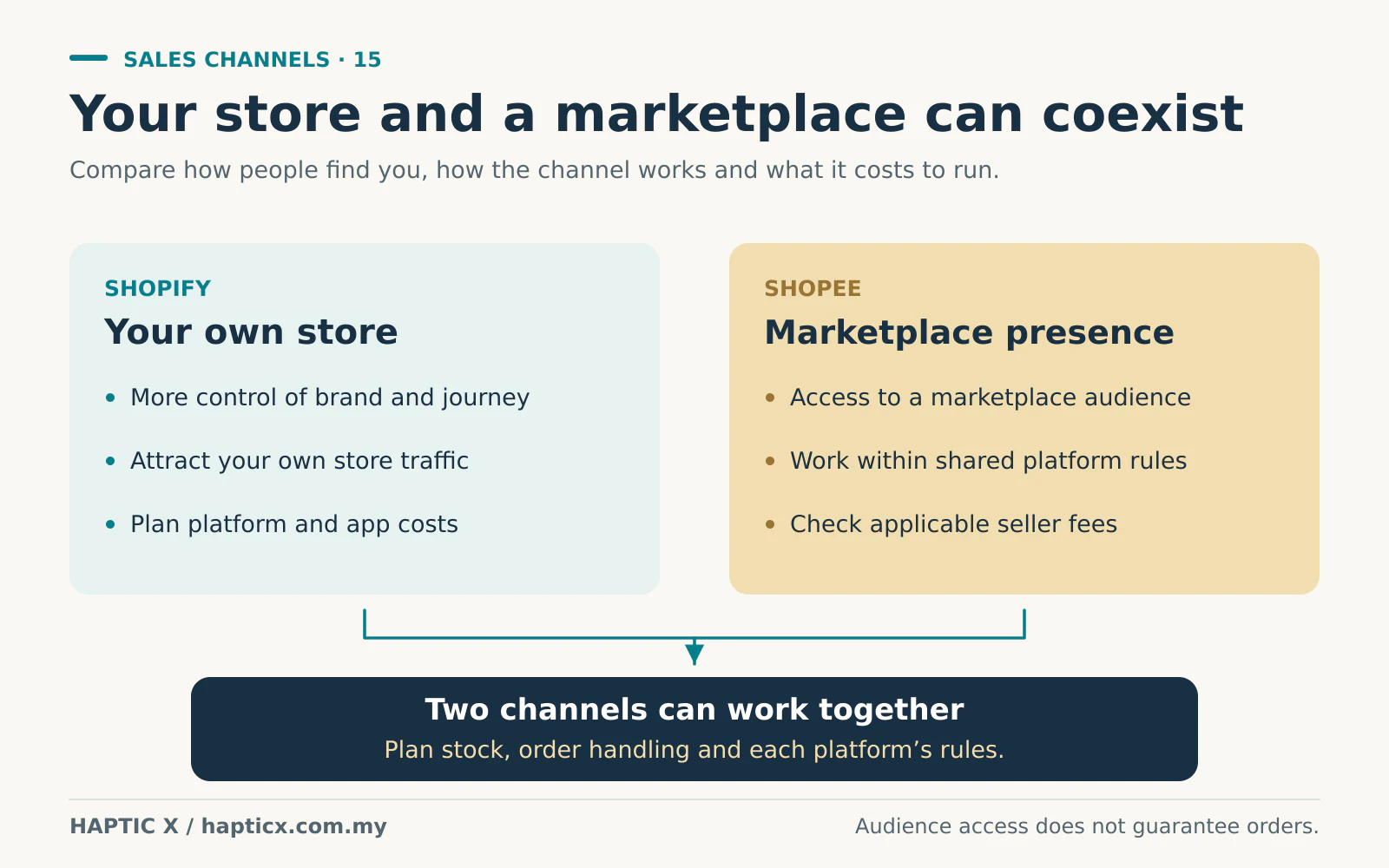
You do not have to close your Shopee shop when you launch an independent store. But the same stock cannot be managed as if the channels are unrelated.
Suppose you have twenty units on the shelf. Both channels show twenty available. A busy promotion can create a problem if the quantities are not updated together.
Decide which stock record your team trusts. Use a tested connection or a simple allocation your team can maintain. Agree who handles messages, refunds, packing and order updates on each channel.
Ask what happens when an integration is delayed or fails. Staff need a way to identify the affected orders and correct them. A new website should improve the selling process, rather than add another screen that nobody checks.
Build the customer relationship properly
An independent store gives you a place to present your brand consistently and make repeat buying easier. That only helps if customers have a reason to return: useful information, a suitable product, reliable fulfilment or an easier ordering process.
Give people a clear choice if they want updates or marketing messages. A marketplace purchase is not permission to add someone to every contact list. Keep marketplace interactions within its rules and use transparent sign-up choices on your own store.
The useful aim is a smoother experience for the customer. “We have our own website now” is not a benefit by itself.
Which should you work on first?
If you are still testing demand, start with a range you can manage and record the real cost of selling it. If you already have customers asking for an easier way to reorder or understand your range, that is a concrete reason to consider your own store.
If you already use both, review them together. Compare the money left from orders, repeat buying, fulfilment mistakes and staff workload. Improve the weak step before adding more products or paying for more traffic.
Tell us how you sell today
Share your product range, current channels and the parts that take too much time. Haptic X's eCommerce website service can help you plan an independent store around those needs, with the daily work considered from the start.
Sources
Official sources checked on 1 November 2026. Fees and plans can change; use your current seller terms and subscription checkout before making a commitment. Shopify MYR prices were observed on the live Malaysia page in the browser.
- Shopify Malaysia, platform plans and live pricing: https://www.shopify.com/my/pricing
- Shopee Malaysia, Terms of Service, including seller responsibilities and fee provisions: https://help.shopee.com.my/portal/4/article/77215
- Shopify Help Center, third-party transaction fees: https://help.shopify.com/en/manual/your-account/manage-billing/billing-charges/types-of-charges/third-party-charges/third-party-transaction-fees
Frequently asked questions
01Is Shopify another marketplace?
No. It supplies the platform for your store. You still need to organise how customers find the website.
02Is Shopee always the cheaper choice?
Use your actual costs and sales process. A low starting commitment does not tell you the final margin on an order.
03Can we keep both channels?
Yes, if stock, enquiries and fulfilment are managed properly. Give each channel a reason to exist.
04Does every seller need an independent store immediately?
No. Know what the store will improve, where its customers will come from and who will operate it before investing.
05Does our own store remove transaction fees?
No. Payment-provider charges and applicable platform fees still belong in the budget.[1][3]