How Much Does a Business Website Cost in Malaysia?
Explore website design prices in Malaysia, what affects your quote, and which design, content and support costs to compare before choosing a web agency.

On this page9 sections
When you ask, “How much does a website cost?”, we need to ask one more question: what do you need it to do?
A website that introduces your company and receives enquiries is one job. A store that accepts payments, calculates delivery and updates stock is another. A system that manages your sales team, warehouse and accounts involves much more work, even if its screens look simple.
That is why comparing prices without comparing functionality can be misleading. You might be paying less because you need less. Or you might be paying less because something important has been left out.
Here is a practical way to decide what is worth paying for.
First, which type of website or system do you need?
These figures give you a starting point for a budget conversation. The published Haptic X prices are package starting points, while the clearly marked estimates are planning allowances for a defined first version. They are not Malaysian market averages, fixed quotations or maximum prices.
| What you want to build | Starting budget reference | What that figure means |
|---|---|---|
| Corporate website | RM1,800–RM6,800+ | Haptic X's published Starter, Business and Premium starting prices are RM1,800, RM3,500 and RM6,800.[1] |
| eCommerce website | RM3,500–RM15,000+ | Haptic X's published store starting prices are RM3,500, RM6,500 and RM15,000.[2] |
| Company-controlled AI chatbot application | Illustrative RM8,000–RM30,000+ | A development allowance for a scoped application with selected business information or connections; model usage and infrastructure are separate. |
| First phase of a custom ERP system | Illustrative RM18,000–RM60,000+ | A limited set of connected operational functions, not every department and process in a large company. |
| Focused custom business system | RM8,000–RM35,000+ | Haptic X publishes RM8,000, RM18,000 and RM35,000 starting points for different custom software scopes.[3] |
| First version of a mobile app | Illustrative RM30,000–RM80,000+ | A simple-app planning reference from one Malaysian developer's published guide, not a market-wide average.[4] |
The AI and ERP allowances are editorial estimates using a limited first phase as their basis. Haptic X's published custom software prices provide adjacent context; they do not establish a fixed price for either project.[3] Complex approvals, data migration, integrations or larger rollouts can take the budget well beyond these ranges.
Unless the quotation includes them, allow separately for taxes, hardware, hosting, licences, payment charges, AI usage and ongoing support. Ask for the actual inclusions before treating any number as your final budget.
The expensive part may be what happens after a click
Imagine two businesses with a “Request a Quote” button.
For the first business, the button opens a form. The customer enters a name, phone number and message. Your team receives an email and replies manually.
For the second, customers choose materials and quantities. The website calculates their dealer price, checks availability, sends an unusual discount for approval and creates a quotation in another system.
Both websites have a button. They are doing very different jobs.
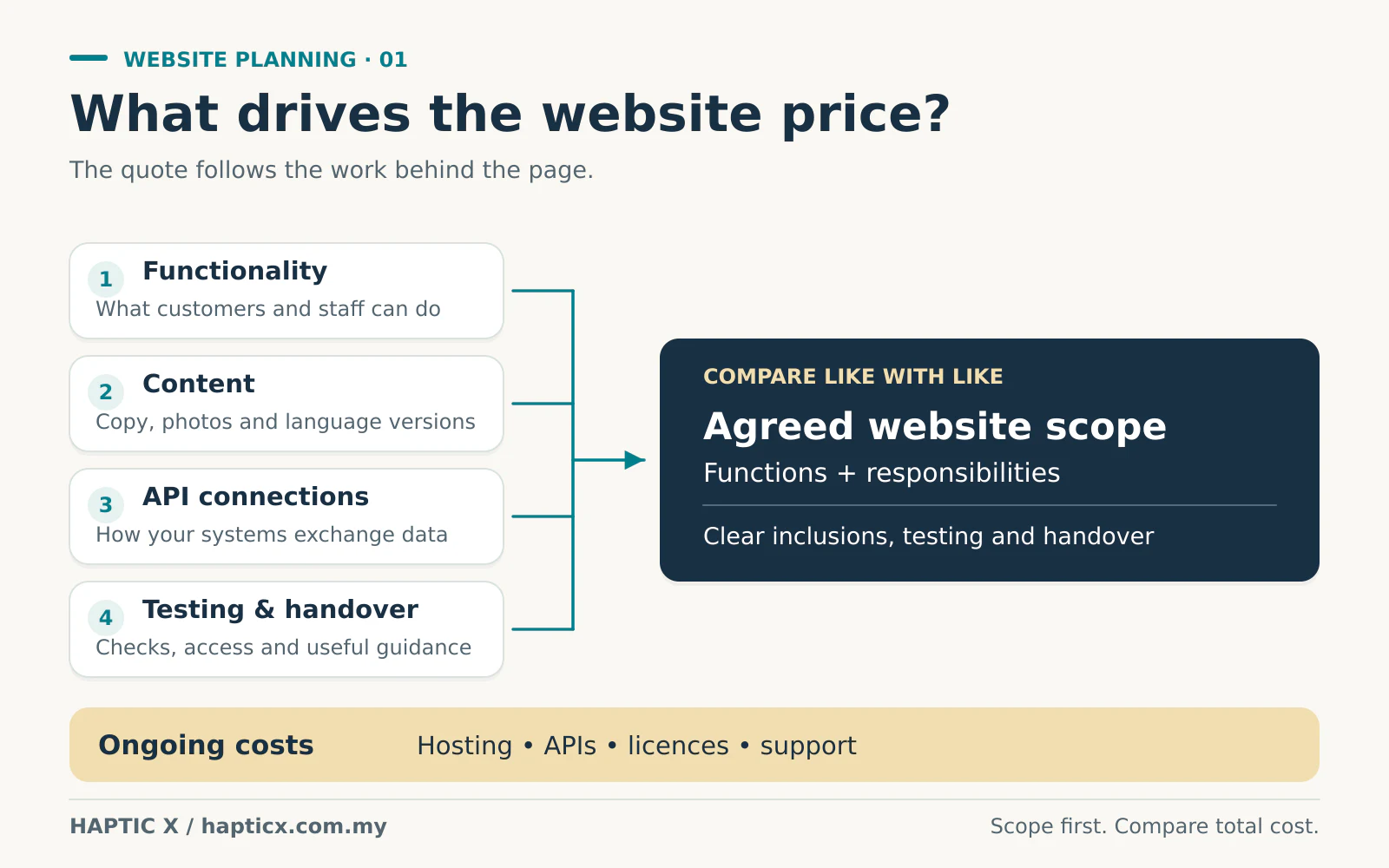
This is why “five pages” or “ten pages” does not explain the whole price. Describe the steps behind those pages: who enters information, what the system calculates, who approves it and what happens when something goes wrong. Those details help a developer give you a meaningful quotation.
Content matters too. Providing finished product photos and approved English copy is different from asking the team to organise your information, write it and prepare several language versions. Agree who supplies what.
What is an API, and why can it affect the price?
Think of an API as an agreed way for two systems to exchange information.
For example, your online store receives an order and tells your stock system which items were sold. That sounds straightforward. Now ask: does the stock system also send updated quantities back? What happens if it is unavailable? Could a repeated payment notification create the same order twice?
These are practical questions, not technical extras for the sake of it. Someone must define the rules, build the connection and check what happens when information is missing or delayed.
“API integration included” is too vague on its own. Ask which systems connect, which information moves, in which direction, and who resolves failures. Existing, well-supported connections can be simpler than a new integration built around unusual business rules.
If your company owns the AI chatbot, are there still fees?
Yes, potentially. Owning or controlling the application is different from running the AI model yourself.
You can commission a chatbot application for your company while it sends questions to a hosted model API. There may still be model usage charges, server costs and support. A simple product FAQ assistant is also a different project from one that checks customer orders, reads private documents and restricts answers according to staff roles.
A genuinely self-hosted model needs computing resources, storage, security and someone to operate it. Tools such as Ollama support local operation, but you still need to choose and configure the deployment appropriately.[5] Renting a cloud server also means using an infrastructure provider.
So ask what you are buying: the application, the source code rights, the deployment setup, the model licence, or some combination. Ask where information goes and who holds the accounts. The contract should explain ownership and handover; the word “custom” does not settle those questions automatically.
A cheap website can become an expensive routine
You get what you pay for only when you know what you are paying for.
Suppose the website launches, but every two weeks another problem needs attention. The form stops working. A price calculation is wrong. A function you assumed was included turns out to be an additional charge. Each time, you explain the problem, wait, check the fix and ask your staff to check again.
Even a small repair bill adds up when the same cycle keeps happening. Your time matters too. The owner should be running the business, not acting as a permanent tester for unfinished work. If you keep paying and checking again every two weeks, are you still saving money?
This is the value we want you to compare: a clear scope, properly tested functions and a useful handover. For a defined project, you might agree one to three review rounds before approval; the actual allowance belongs in your quotation. The aim is to finish the agreed work, make the planned adjustments and let you use the website confidently, instead of bringing you back into another repair cycle every fortnight.
There should also be a clear distinction between correcting a defect in an agreed function and adding a new function later. Think about the foundation you want to keep improving over five or ten years, and perhaps longer as the business changes. That is a better value question than the lowest bill today. The lifespan depends on the build and its upkeep; a higher price by itself cannot promise it.

Look at the cost after launch
Write down the initial build price, then add the expected running costs over a period such as three years.
A lower setup price may come with subscriptions. A larger custom build may reduce some recurring extension fees but still need hosting, API services and technical care. Neither arrangement is automatically bad. What matters is whether the total cost makes sense for the work the system performs.
Ask what happens when you need a new staff role, another language or a change to your delivery rules. You do not need every possible feature on day one, but you should understand the likely next step.
Tell us what your business needs to do
Start with an everyday example: “A customer sends us this information, our staff do these steps, and this is where we get stuck.” That is more useful than a long list of technical terms.
Explore Haptic X's corporate website service or custom software development, and bring the functions you need now and the ones you can leave for later. We can then discuss a scope you can actually compare.
Sources
Sources checked on 1 November 2026. Prices are reference information and may change.
[1] Haptic X, Corporate Website Design: published package starting prices and scope.
[2] Haptic X, eCommerce Website Design: published store package starting prices.
[3] Haptic X, Custom Software: published RM8,000, RM18,000 and RM35,000 starting points; used as adjacent context for illustrative system allowances.
[4] Techies App Technologies, Mobile App Development Cost in Malaysia: the provider's simple-app estimate.
[5] Ollama, FAQ: local-only deployment and cloud features.
Frequently asked questions
01Is RM1,800 enough for a business website?
It is Haptic X's published Starter starting price.[1] Whether that scope suits you depends on your content and required functions. Compare the current inclusions with what your business actually needs, then request a confirmed quotation.
02Why can two websites that look similar cost very different amounts?
The visible design may hide different work: pricing rules, customer accounts, permissions, payments, integrations and testing. Ask each provider to explain the functions included, not only the number of pages.
03Does paying once mean I own everything?
No. Ownership, account access and source code rights depend on the agreement and third-party licences. Domain renewals, hosting, paid services and support may continue even when the development work is paid in full.
04Can I build the website first and add a system later?
Often, yes. Explain the likely next phase before development starts so the team can consider the data and integration requirements. A simple first phase can be good value; a first phase that ignores a known dependency can create avoidable rework.
05Will a more expensive website guarantee more sales?
No. A properly scoped website can make enquiries and purchases easier, but sales also depend on your offer, pricing, traffic and follow-up. Ask for evidence of working functionality, rather than treating price as a sales guarantee.