ERP Implementation Costs: Software, Migration and Support
Understand ERP implementation costs, from software and configuration to data migration, training and support. Plan a budget around your project scope.

On this page13 sections
One company asks for an ERP quotation and receives RM20,000. Another receives RM50,000. Both say they want an “ERP system.”
Why is the price so different?
Usually, the work behind that name is different. The price depends on the functions, business rules, old information and other systems that need to be connected.
For a limited first custom ERP phase, RM18,000–RM60,000+ is a useful starting allowance for discussion. This is our planning estimate for a defined SME scope, not a Malaysia-wide average or a fixed Haptic X package. A larger operation with multiple branches, complex stock or manufacturing can cost considerably more.
The way to get a useful price is to explain what must happen in your business.
“ERP” can mean very different amounts of work
Imagine two businesses.
The first needs customers, quotations and order status. A salesperson enters the order, the boss approves it and the team completes the job.
The second has six branches. Each branch has separate stock. Different customers receive different prices. Discounts need approval. Goods move between branches. Finance needs to match payments, and management wants a combined report.
Both businesses may call that an ERP. The second system has many more rules to build and test.
It is like renovating a shop. Moving a few shelves and changing the signboard costs differently from rebuilding the layout, wiring and plumbing. We need to know what you want before a number means much.
1. What functions do you need?
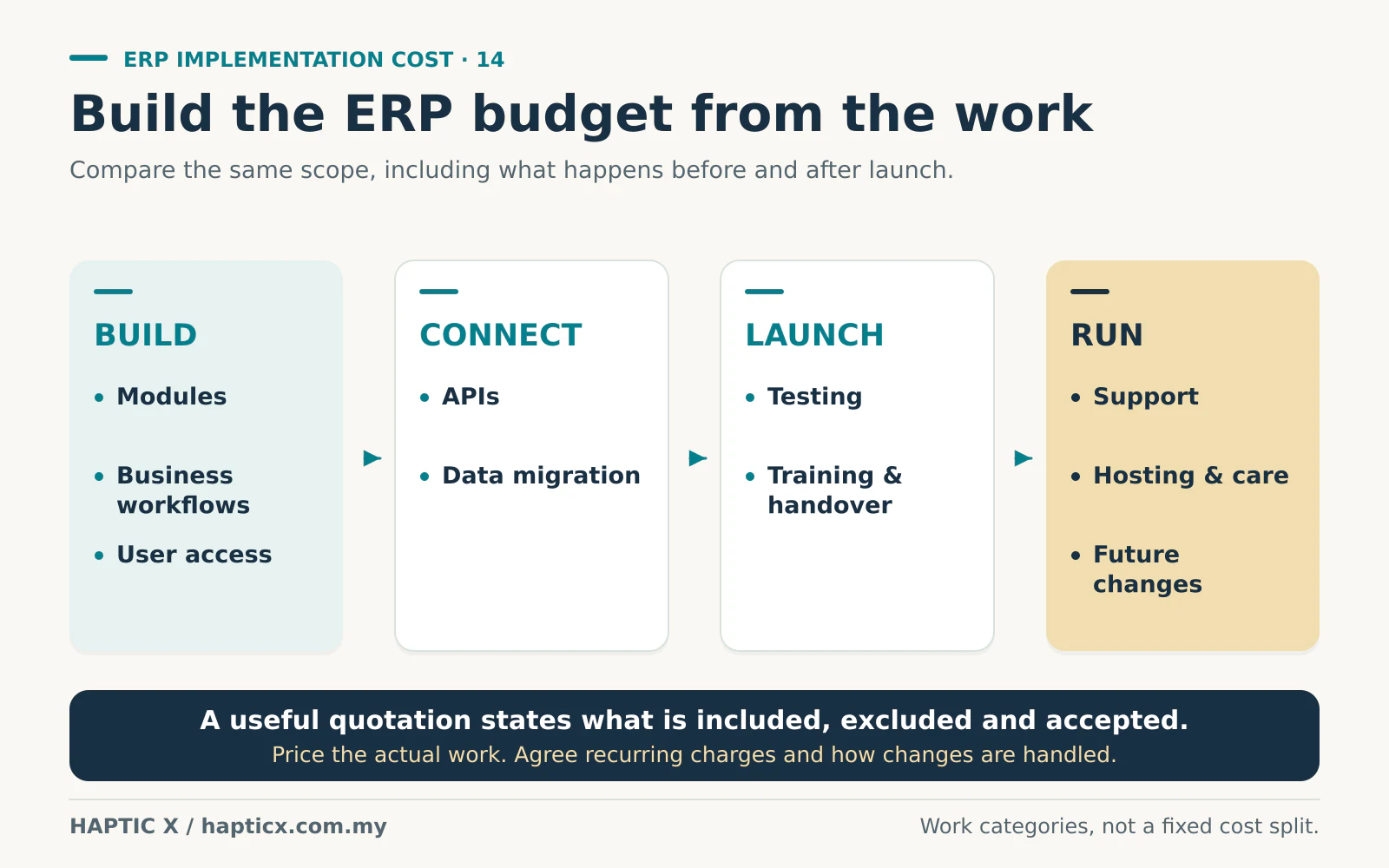
You may hear the word module. It simply means a group of related functions: stock, purchasing, sales, customer records or another part of the business.
Start by listing what the team must do.
Do you need to prepare quotations? Track production? Approve expenses? Record deliveries? Calculate commissions? Let customers check order progress?
Then explain the details. “We need quotations” is a starting point. “Every customer has an agreed price, a large discount needs the manager's approval and approved quotations become orders” is much easier to price.
A function that looks like one small button on the screen can involve several decisions behind it.
2. How many people and branches use it?
Ten people doing the same work in one office is different from ten branches with different stock and responsibilities.
Decide who can see, edit, approve, export or delete information. A salesperson may need customer prices without seeing the company's full profit report. A branch manager may need their branch's figures without changing another branch's stock.
An existing ERP product may charge by user or package. A custom system may use a different pricing arrangement, but more activity can still affect server capacity and support.
Ask what is included for the people you have now and what happens when the team grows.
3. What old information needs to move?
This is another part people easily miss.
You may have customer names in one spreadsheet, outstanding payments in another and product photos in several folders. Some records may be duplicated or out of date.
Someone must decide what to keep, clean the information, match it to the new system and check that it arrived correctly. That is called data migration. Microsoft treats it as planned and tested implementation work.[1]
Ask whether your quotation includes current records only or years of history, attachments and opening balances. Also ask who cleans the information and who checks the totals.
“Upload our Excel file” can be a small job or a much bigger one, depending on what is inside it.
4. Which APIs and outside services must connect?
An API lets one system pass information to another.
For example, your online shop receives an order. The ERP receives the customer and product details. A payment confirmation updates the amount paid. The accounting system receives the agreed invoice information.
That can save your staff from entering the same order several times.
The price depends on how much information moves, which system controls it and how mistakes are handled. A straightforward connection is different from several services updating stock and payments throughout the day.
Check whether the other provider allows the connection, whether your plan includes access and whether it charges for usage. Paying a developer to build the connection does not pay the other provider's bill.
5. What happens after the developer finishes building?
Your staff still need to use it.
They should test real work, including changed orders, partial payments and limited staff access. The team needs training, and someone needs to support the first days of use.
Testing, validated data, business acceptance and operational support are also part of Microsoft's go-live checklist.[2]
When a quotation says “training included,” ask what that means. One demonstration? Training for each department? Short instructions? Support when staff use it on their own?
Those details affect the value of the price.
A simple way to read the quotation
| Your situation | How we would approach the budget |
|---|---|
| An existing ERP already fits the work | Compare its software fees with setup, migration and support |
| A limited first custom phase | Use RM18,000–RM60,000+ to begin a scope discussion |
| Several branches, manufacturing or complex integrations | Review the process first; costs can go well beyond that initial range |
| More functions after launch | Price the addition together with testing and any effect on existing work |
You do not have to build every module immediately. A sensible first phase can fix the biggest daily problem and leave room for the next stage.
Where can RM30,000 go?
Here is a fictional example, to show how a project budget might be divided. It is not a quotation for your company.
| Work | Example allocation |
|---|---|
| Understand the workflow and agree on the scope | RM3,000 |
| Build or configure the main functions | RM15,000 |
| Prepare data and build one agreed connection | RM5,000 |
| Test the work and resolve problems | RM4,000 |
| Train the team, launch and hand over | RM3,000 |
| Total | RM30,000 |
If a cheaper quotation leaves out the last three rows, you may need to arrange and pay for that work later.
That is why comparing only the total at the bottom can be misleading. Ask what your team will actually receive.
You get what you pay for, including the time you save
Suppose the system is cheaper, but every two weeks someone finds another problem.
Sales cannot change an order properly. The warehouse sees the wrong quantity. The boss spends another afternoon explaining it. A small fix costs extra, and staff repeat the work while waiting.
Did the company save money? The first invoice may be lower, but the time cost keeps growing.
We would rather see the important process properly understood, built and tested, with planned reviews to settle the agreed first version. For a suitable scope, one to three review rounds may be agreed before acceptance. New requests and later changes should have their own clear process.
Pay more when it buys better work: fewer manual steps, reliable information, useful testing, training and support. A higher price by itself is not evidence that those things are included.

What will you pay after launch?
A custom function may be paid for once as part of development, instead of carrying a separate monthly feature subscription. Confirm the ownership and licence terms in writing.
The system still needs somewhere to run. Hosting, backups, monitoring, maintenance and paid outside services can continue.
For illustration, RM600 a month over three years adds RM21,600. That is arithmetic, not a quoted maintenance package. Use the actual support price when comparing your options.
If you want the system to serve the company for five, ten or more years, plan for care and improvement. Your staff, processes, devices and connected services will change. A well-planned foundation makes that easier to manage; it does not remove every future update.
Show us what you want the system to do
You do not need to prepare an IT specification. Show Haptic X how a normal order or job moves through your company and where time is being wasted.
We can help prepare a phased ERP system proposal you can understand. Our ERP implementation guide explains how to move from the quotation to a system your team can use.
Sources and estimate basis
Reviewed 1 November 2026. All RM planning allowances and worked examples above are editorial illustrations, not quoted market averages or published vendor tariffs. They must be replaced by a project-specific quotation before purchase.
[1] Microsoft Learn, Manage configuration and migration data: https://learn.microsoft.com/en-us/dynamics365/guidance/implementation-guide/data-management-configuration-data-migration
[2] Microsoft Learn, Go-live checklist: https://learn.microsoft.com/en-us/dynamics365/guidance/implementation-guide/prepare-go-live-checklist
Frequently asked questions
01Is RM18,000–RM60,000+ an official Haptic X package?
No. It is an initial planning allowance for a limited custom ERP phase. We need the actual functions, users, data and connections before preparing a quotation.
02Can we start small?
Yes. Start with connected tasks that remove a real daily problem. For example, quotations, approved orders and job status may be a useful first phase.
03Will custom development remove monthly fees?
It may remove some feature or user subscriptions, depending on the agreement. Hosting, support and external services still need to be considered.
04Why does an API connection cost extra?
Someone must build and test the exchange of information, including failed requests and duplicate updates. The other provider may also charge for access or usage.
05What should a good ERP quotation include?
The functions and rules, users and permissions, data to be moved, named connections, testing, training, ownership and support. It should also explain how included revisions, defects and new requests are handled.